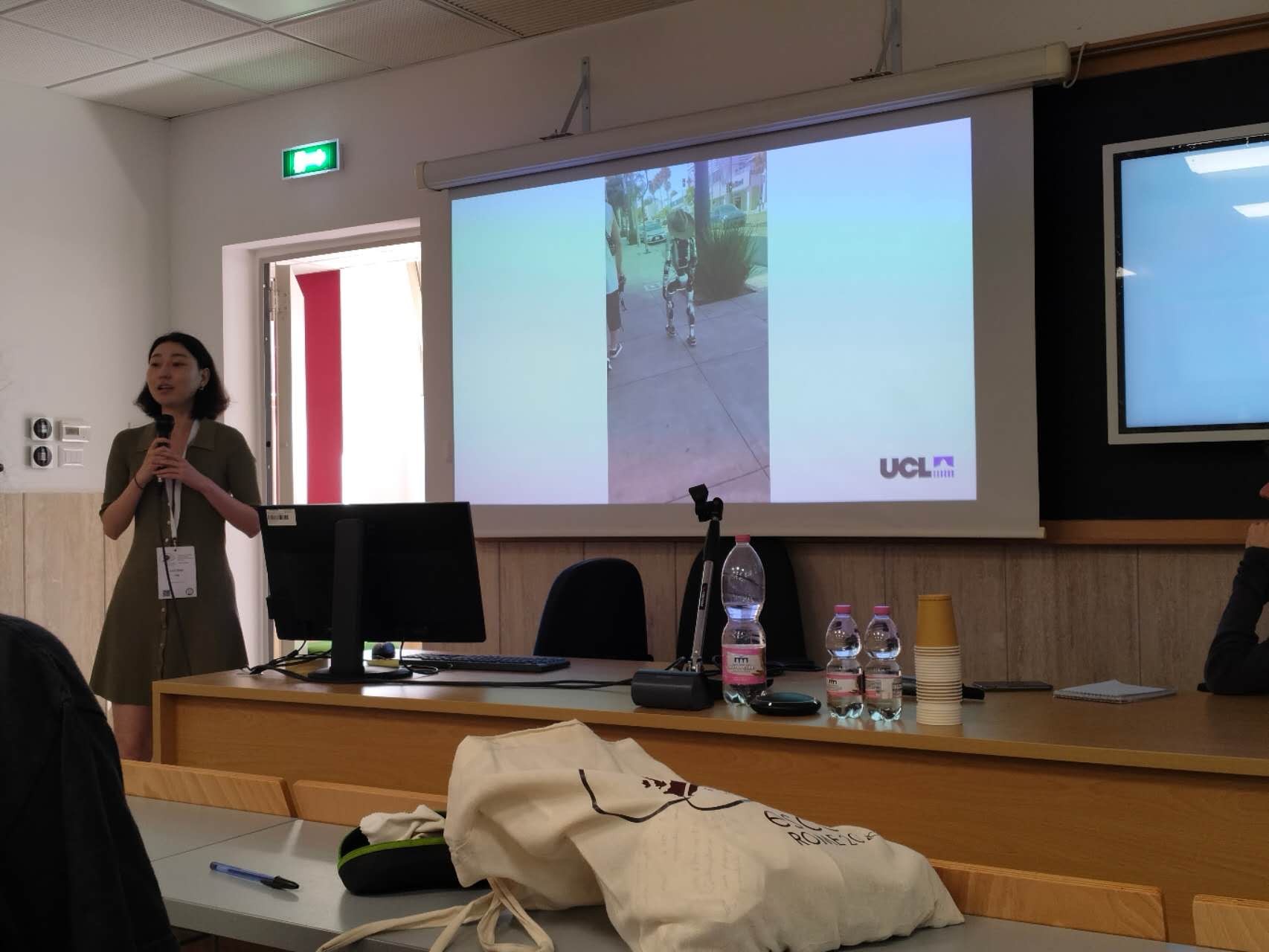
Congratulations to Ceci Qing Cai who presented her talk “When AI sounds human: discriminating human and AI-generated emotional vocalizations in autistic and non-autistic adults”, at ESCAN 2026, the European Society for Cognitive and Affective Neuroscience conference. AI voices are becoming increasingly convincing, but do we all hear them in the same way? We explored how autistic and non-autistic adults perceive human and AI-generated vocal emotions.
AI vocal emotions sounded surprisingly human-like, although real human voices still had the edge. More interestingly, subtle group differences emerged. Non-autistic adults showed a clearer difference between positive and negative emotions in recognition accuracy, while autistic adults tended to feel less confident, particularly when emotions were more ambiguous. They also showed a tendency to find contentment – a highly ambiguous positive emotion – harder to recognise.
A huge THANKYOU to Davide Bono – Ceci’s operator trainer! He is such a considerate and helpful person to work with, and Ceci went through an informative, thoughtful and joyful operator training with him!
Ceci is now a qualified MRI scanner operator – ‘the Queen of Avanto’ (Davide, 2021)! She will continue the data collection for her last PhD project on Avanto 1.5T scanner with Ozzie, Claire, YG and Lucie.
(Ceci & Davide by Yuxi Xiong – a talented participant in this project!)
By adding laughter in front of bad ‘Dad’ jokes, the jokes were perceived to be funnier. And the kind of laughter had a further effect on the funniness of the jokes. Spontaneous ‘real’ laughs made jokes even funnier than adding posed ‘fake’ laughter. Also, we found the same modulation of funniness by laughter in autistic adults.
This paper received a high amount of media attention.
And it was the most read paper on the Current Biology website